Friday, 26 May 2017

Developers (Willis O'Brien)

Willis O'Brien (1886-1962) - Who is he?

Image result for willis o brien

Willis worked with stop motion animation along with motion picture special effects. He would be best remembered for the work he has done on King Kong (1933) as well as The Lost World (1925). ASIFA-Hollywood had said that "he was responsible for some of the best-known images in cinema history". Due to O'Briens insane interest within dinosaurs when he was younger, this had probably the main inspiration in terms of why he had that concept in many of his films, such as The Lost World. 

With his early short films he would tend to create his own characters out of clay. However in his recent career he has generally tended to employ people to create more detailed models, which were based on his own designs. These included rubber skin which was built up over metal armatures. The models tend to include a bladder inside the skeleton model which were there to be able to inflate and deflate, which generally created the illusion of clay animations breathing. This made it so that O'Briens models for his films looked more realistic as well as having a clever new technique within his films. 

O'Briens techniques generally included combining realistic stop-motion animated models with live action which is shown in many of his films, an example in which it is shown in would be 'King Kong'. 

Thomas Edison was generally impressed with Willis work that he eventually ended up hiring him to work with him and the company to animate a series of shot films. This included other animators O'Brien worked with, which included George Pal. Willis may have seen both of the animators as being role models in the way of being a good influence and therefore he would of found in honourable to work with the pioneers of his work. 

On two separate occasions O'Brien had his film ideas which there were developed by someone else who then made them films. Whereby O'Brien wasn't actually involved with the production. Within the King Kong film, stop motion animation was being used. The image above shows O'Brien when he is positioning the models into the correct positions. And the video below shows the stop motion animation dinosaurs from the film 'The Lost World'. (1925)

George Pal (Pioneer)

George Pal (1908-1980) - Who is he? 


Image result for george pal

George Pal was an animator and film producer of the genre, science fiction. He made the Puppetoons series in the 1940s, this was animatied puppets films which were made using wooden puppets within a stop motion animation technique. A typical Puppetoon would require 9,000 individual carved and machined wooden puppets. The overall technique of using puppets within stop motion animation was originally created by George Pal. George Pal is the best remembered as the producer of several science fiction and fantasy films within the 1950s and 1960s. 'The Rocky Horror Show', he was one of the references to this stage musical. 

George was actually signed to Paramount Pictures in Holland, which was where many other famous animators were working, such as Ray Harryhausen. Due to his genre within stop motion animation being science fiction, this generally shows how stop motion has developed over the many years, as nothing like this has been done before. He was generally famous due to his puppets, whereby some had lots of heads. This may have been due to the influence for the modern film A Nightmare Before Christmas, where the model Jack Skellington had around four hundred heads, which allowed the expression for mass amounts of emotion. 

With the series 'Puppetoons' I generally feel that the target audience would have been children, this would generally be due to the fact of being able to see the television poster for this which is shown above on the right. The puppetoons are children themselves as well as the colours and the fact the puppets are generally swinging could indicate that it is aimed towards children. 

Bibliography:

"George Pal - Bio, Facts, Family | Famous Birthdays". Famous Birthdays. Web. 26 May 2017.
http://www.famousbirthdays.com/people/george-pal.html

Lumiere brothers (Pioneers)

The Lumiere brothers, (Auguste 1862-1954) (Louis 1864-1948) - Who are they?


Related image

They were the earliest filmmakers within history. They began creating moving pictures in 1892 and legally protected a number of processes leading up to their film camera. The brothers actually worked together to overcome the limitations in which they saw within Edison's kinetoscope/ kinetograph. They did notice that the camera of the device was actually too large and heavy which therefore meant they would make their invention much smaller as well as more lightweight. Which for them, was therefore seen as an improvement. The device was invented in 1895, which was combined by camera and printer and projected and was called the Cinematographe. 


The brothers kept their invention private which therefore on their first film screening which was shown on March the 19th 1895 and the audience wouldn't of been expecting this as it would have been the first time they had seen the brothers invention. Back in the day this would have been a huge deal for both the lumiere brothers as well as the audience. Due to their continuous use of private screenings, the audience would of generally been very loyal to have gone and watched their films. The brothers then began to start opening theatres, which are generally now known as cinemas.

Bibliography:

The Lumière Brothers, Pioneers of Cinema. "The Lumière Brothers, Pioneers Of Cinema - History In The Headlines". HISTORY.com. N.p., 2014. Web. 26 May 2017.
http://www.history.com/news/the-lumiere-brothers-pioneers-of-cinema

Pioneers of Animation (Kinetoscope)

What is a Kinetoscope?

The kinetoscope is an early motion picture exhibition device which was initially designed for films to be able to get viewed by one individual at a time through a little hole within the top of the device. 

Kinetoscope, which is the forerunner of the motion-picture film projector, this was invented by Thomas A. Edison as well as William Dickson of the United States in 1891. The 'Library of Congress Motion Picture, Broadcasting and Recorded Sound Division and Washington, D.C.

This was designed generally for films to be able to be viewed by one person at a time and through a viewer window at the top of the actual device. It actually introduced the basics of cinematic projection before video. It was invented within the 1880's, 1888 to be exact by Thomas Edison. Edison's encounter with Eadweard Muybridge actually inspired him to want to develop the motion picture system. Eadweard eventually proposed that they could combine their devices together, which when combines would offer they could play sound and images at the same time. The collaboration was not untaken. However, Edison later filled for a patent which was used as a source for the development of his kinetoscope. The image below shows exactly how the kinetoscope was being used. As it shows someone looking into it from the top of the device, and seeing the illusion of moving pictures within. 


Bibliography:

"Kinetoscope". En.wikipedia.org. Web. 25 May 2017.
https://en.wikipedia.org/wiki/Kinetoscope

"Kinetoscope | Cinematic Device". Encyclopedia Britannica. Web. 25 May 2017.
https://www.britannica.com/technology/Kinetoscope


Eadweard Muybridge (Pioneer)

Eadeward Muybridge (1830-1904) - Who is he?

Image result

He was a photographer who was important for his work involving the studies of motion, and within in motion-picture projection. In the 1880's he actually produced images of animals as well as humans within motion, overall capturing exactly what the human eye could not see as separate movements. Eadward experimented with a horse in motion in which he lined up cameras against a horse race track whereby the shutter of each of the cameras was triggered by a thread as each individual horse had passed. The end result of this is shown in the picture beneath, showing the illusion of movement had been created. 

Muybridge, would then copy the images onto a disc to then be able to view it within a machine in which he invented which was known as the zoopraxiscope. This device was invented in 1879 and would/ could be considered the first movie projector. The way in which the device worked was that it would project images from rotating discs which would give the impression of movement. The zoopraxiscope was one of the inspirations from the kinetoscope, which was the first commercial film system.

Thursday, 25 May 2017

Pioneers of Animation (Praxinoscope)

What is a Praxinoscope?

A praxinoscope was generally seen as an animation device, as it is similar to a zoetrope. It tends to use a strip of pictures which are placed around the inner surface of a spinning cylinder. The actual praxinoscope has mirrors within the centre with frames at the side that has been placed within a shallow outer cylinder. This is to be able to see the movement of the animation as you begin to start spinning it and look at the mirrors. The overall number of mirrors are seen to be equal to the actual number of pictures so that the images of the picture are viewed within the mirrors. The pictures in which are reflected back give an illusion of moving pictures, which when the outer cylinder is rotating. This was invented by Charles-Emile Reynaud in 1877. 

When comparing the praxinoscope and the zoetrope, the praxinoscope was better as each mirror in which the praxinoscope projected showed a clearer image opposed to it. Whereas with the zoetrope it lost a lot of luminosity in the movement whereas the praxinoscope Reynaud adapted the praxinoscope so it would be proejcted whereas the zoetrope wouldn't/couldn't be. The replacement of the opaque drawings with transparent drawings which meant that the light could shine through them. 

Praxinoscope, this was developed initially for theatrical entertainment which involved painting series of pictures on small glass plates which were then joined together within a single flexible strip. The animated characters were then projected onto a screen from behind. 


Bibliography:

"Praxinoscope". En.wikipedia.org. Web. 25 May 2017.
https://en.wikipedia.org/wiki/Praxinoscope


Pioneers of Animation (Zoetrope)

What is a Zoetrope?

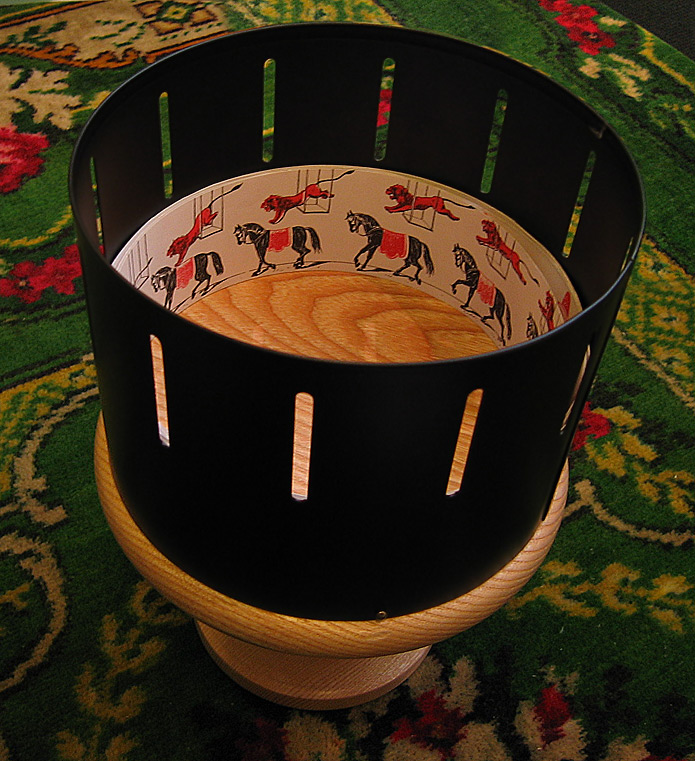
This is a 19th century optical toy which generally consists of a cylinder which contains a mass of pictures on the inner surface which when viewed through the slits with the actual cylinder rotating, this gives of an impression of continuous motion. 

The very first zoetroped in which was invented was in China by a man by the name of Ding Huan in 180 AD. However, in 1934 the modern zoetrope was invented by a man known as William Horner, who originally called it by the name of Daedalum which means the Wheel of the Devil. 

This was based on Plateau's phenakistoscope, but was deemed more convenient as it didn't require a viewing mirror and as it also allowed more than one individual to use it within the same period of time. 


This is a modern day replica of Victorian Zoetrope. 

If you're still confused as to what a Zoetrope is, it basically is one of the several pre-film animation devices in which was used to be able to produce the illusion of motion simply by displaying a variety of sequences of drawings and or photographs which showed the progressive phases of that specific motion. 


Bibliography:

"Zoetrope". En.wikipedia.org. Web. 25 May 2017. 

Pioneers of Animation (Phenakistoscope)

What is a Phenakistoscope?

This was an early animation device which used for the persistence of vision principle which was then used to create an overall illusion of motion. The phenakistoscope consisted of two discs which were mounted onto the same axis. With the first disc this has a slot around the edge, and the second disc actually contains drawings of a successive action which is drawn around the disc within concentric circles. Once the phenakistoscope actually begins to spin together within the same direction, the mirror shows the first disc's slots, then the pictures within the second disc will begin to appear to move. Belgium physicist Joseph Plateau and his sons actually introduced the 'Phenakistoscope' in 1832. 

There was actually two different types of illusions which two different people created the phenakistoscope was created within 1832 by Plateau which they used mirrors to be able to create an illusion of movement by earlier the Micahel Faraday's Wheel which was created, this consisted of two discs which spun in opposite directions, this again created the illusion of movement.


Bibliography:

"Phenakistiscope". En.wikipedia.org. Web. 25 May 2017. 

https://en.wikipedia.org/wiki/Phenakistiscope

Wednesday, 17 May 2017

The History of Frame Rates

Frame Rates History:


What is the phi phenomenon? 
- The phi phenomenon is the optical illusion of perceiving a series of still images, when viewed in rapid succession, as continuous motion. First described by  Max Wertheimer, one of the three founders of Gestalt psychology, defined this phenomenon in 1912. The human brain can only perceive about only 10-12 individual images per second, any faster, our brains blend the images together into motion. 

What is the significance of 12fps?
- This was the first frame rate. Which gives/ plays back 12 frames per second (fps) with 12 intermittent periods of black as the film advances it will create an intolerable amount of flicker. To make the flicker not black Thomas Edison mentions that it would require 46 frames per second. 


What is over cranking?
- This is when you record a fast frame rate than  the final projection. D.W Griffiths was notorious for doing this, shooting as low at 2 frames per second, even Eddison ignored his own recommendation.


What is under-cranking?
- This is where you record a slower frame rate to the final projection.

What impact did the introduction of sound have on frame rates?
- Sound was generally such a huge technological advancement/ achievement that changed the way of film in a drastic way. Frame rates were required to be kept at a strict rate and was established in 1929 as 24 frames per second. It was made 24 frames per second as sound tracks didn't have the fidelity on 16 frames per second systems. They used 24 frames per second projection within a double bladed shutter which kept to the desired 48 projected frames per second. 


Why 24 became the international frame rate standard?
- The audio track didn't have enough fidelity, so this way they settles for the next factor. 24 is a number which can easily be divided by 2,3,4 and 8. 24 
fps became the international frame rate because it was cheapest option rather than going to 30 or 32 fps.

What issues surrounded bandwidth?
- The issues which surrounded bandwidth would be the fact that bandwidth used by the colour sub carrier which potentially interferes with the overall audio signals which cause inter modular beating. The solution to this would generally be that they would reduce the frame rate just by 0.1% which would make the frame rate 29.97 fps. 

What was interlacing?
- This is where a picture is split into the upper field and the lower field. Each field would then be created within the screen one after the other within a comb like pattern. 

How was the challenge of inter modulation tackled?
- To beat the intermodulation, or disortion caused by the hum generated within the electrical current, the refresh rate was set to that of the AC power which in the US (United States) is 60 hertz. 

What is the significance of 60 Hertz and how does it relate to 30 frames per second?
- 60 Hertz is generally equal to having 60 frames per second and with this the screen will have full 30 frames per second. 

What is the difference between VHF and UHF?
- VHF and UHF. VHF can be anywhere from 30 to 300 MHz which was the old black and white television sets. Whereas with UHF this can be anywhere from 300 to 3000 MHz and they were trying to introduce colour to the screens within television sets. 

How was a colour standard arrived at?
- Luminescence and chrominance this is what is giving back when they break down the colour, broadcasters would be able to embed a colour signal as a subcarrier within a television signal. New colour TV's would pick up and interpret the colour subcarrier which would inevitably be ignored by the older black and white TV sets. 

What challenge did bandwidth present to achieving a colour standard and how was this problem overcome?
- The bandwidth which was used by the colour subcarrier would potentially interfere with the audio signal which then caused intermodular beating. The overall solution to this would be to reduce the actual frame rate by .1% which phases the colour and audio signals so that they would never fully match up. 

What was the fields per second ratio that was eventually developed as the standard in colour and what was the resulting frames per second ratio?
- Fields per second went from 60 to 59.94 and with 29.97 full frames per second. 

What is PAL and why was it developed?
- This is a format which is used to solve colour problems which are plagued NTSC and would generally work with the 50 Hertz AC power which is used in Europe and everywhere else around the globe. 

What was the fields per second and frames per second ratios of PAL and SECAM?
- PAL along with another similar format run at 50i for a standard effective 25 frames per second. 

A)Produce a step by step guide to explain how we get from the 24 frames per second of film to a 60i video stream to be able to watch celluloid movies on video.
- First of all with 24 frames per second film this is slowed down by 0.1% and gives up 23.976 frames per second.
- If you were needed to make 4 frames of 23.976 to fit within 5 frames of 29.97. This would be done by splitting the frames into fields using a 3:2 pull-down. 
- The first frame is captured onto three different fields - the upper, lower and then upper field - which is one and and a half frames. The next frame is then captured using the following two fields, lower and then upper.
- The next frame after then fills up the lower, then following upper and lower with the last frame which fills the upper and lower field. 

B)What are the issues with the various conversion?
- The still overall resulted in the video streaming having Telecine judders every 3 frames which is generally/ especially noticeable within long slow camera movements.  

How do modern digital cameras avoid the telecine process and with what effect?
- Modern digital cameras avoided the process involving telecine as they were recording 23.976 or straight 24 frame rates natively onto the hard drive but some workflows generally run through HDMI cables which are rated for 60i. 

How are 24 fps films telecine'd onto SECAM or PAL 25 fps?
- With telecining film onto PAL or even SECAM's the process is/ much simpler. They used 2:2 pulldown which is the 24 frames per second footage which was sped up by 4% and each frame then transferred onto two different fields, upper and lower field. Due to the increased speed this raises the pitch of the audio noticeably by 0.679 semitones or a little more than a quarter. 

Explain high frame rates and temporal resolution.
- 24 fps has generally been the standard fps used within narrative filming for nearly up to a century. Enterprising filmmakers now have tried to push temporal resolution or the frame rate even higher - meaning that they are trying to reduce the motion blur which will create a smoother and more realistic look within film. 

What are the issues with higher frame rates in narrative filmmaking?
- Audiences have generally been able to warm up to the idea of high frame rates within narrative filmmaking. An example of a recent film with a high frame rate would be Peter Jackson's 'The Hobbit'. This film used 48 fps and audiences however didn't appreciate the change, in terms of how it looked, some audiences complained and commented that "the human actors seemed over-lit and amplified". A separate complaint would be that "it looked like a made-for-TV movie". Filmmakers such as Peter Jackson and or James Camera both push for higher frame rates to advance the way in which audiences watch narrative films. 

Friday, 12 May 2017

Persistence of Vision

What is Persistence of Vision?
- Persistence of vision refers to the overall optical illusion of a moving image/ picture which generally is not moving. This is how most animation works as it is to show fluent movement of characters and objects. By showing us a range of different images within a short and or quick space of time, we will be receiving the illusion of movement. 

Thaumatrope and Roller:
- From making these, I can see that it does work as you have to move both of the images rather quickly before you can have the illusion that they are moving independently. This occurs as both images are being moved quickly enough which allows our eyes to see the two images as if though they were moving by themselves. 


Here are two video examples of Persistence of Vision:


Frame Rates

What are Frame Rates?
- This is each individual image and or picture which is in an animation referred to as a frame. The more frames which are utilised the slower the overall action will appear, using fewers frame will create a faster action. Small movements tend to be somewhat smooth, when compared to large amounts of movement as it would either be jerky to some extent or the overall animation won't take place. Typically, smooth actions are slow and use a ton of frames.

The Hobbit An Unexpected Journey:


via GIPHY


Within traditional films, the frame rates tend to be around 24 fps, whereas with digital frame rates they are 30 fps. We can see moving images from as little as 16 fps however with the frame rate being higher, this would mean more frames would be needed therefore making the overall process more costly for filmmakers. 

Peter Jackson, who directed the Hobbit, shot the film with 48 fps which is the twice the normal speed (24fps.) Although this made the process more costly, this allowed the finished production to come out clearer as well as offering a much more detailed picture as opposed to containing motion blur. 

Listing of frames per second/s, minutes (Amount of time)

24 Frames - 1 Second
240 Frames - 10 Seconds
720 Frames - 30 Seconds (Which could be an animated advert)
1,440 Frames - 1 minute (60 Seconds)
14,400 Frames - 10 minutes (600 Seconds) - this would be the average length of a children's animated TV Programme
43,200 Frames - 30 minutes (1800 Seconds) And this would generally be an animated TV programme. 
129,600 Frames - 90 minutes (5400 Seconds) this would be the amount within an animated feature film

Wednesday, 10 May 2017

Stop Motion Animation

What is Stop Motion Animation?

- Within animation, stop motion animation is seen as a cinematic process or a technique in which is needed/used to be able to make static objects appear as if they were moving. This technique is commonly used within clay animation which is also called claymation and also puppet-based animation. Dragonframe. (2017 - Release and Access Year)


Film (Stop Motion Animation): (Examples)


TV (Stop Motion Animation): (Examples)


Advert (Stop Motion Animation): (Examples)


Within this Stop Motion Animation example, you can definately tell exactly why it was a best award winning animation as it clearly shows the amount of time in which was spent into the development of the advert.

Special Effects (Stop Motion Animation): (Example)


Bibliography:


Systems, DZED. "Introduction To Stop Motion Animation - Dragonframe". Dragonframe. N.p., 2017. Web. 10 May 2017.